

Picking up the ACCA qualification is one of the more serious decisions a finance student makes. The exams are tough, the timeline runs into years, and the costs add up fast. Yet registration numbers keep climbing. In 2026, ACCA had over 526,000 students enrolled globally, with India being one of the largest student markets outside the UK.
Part of the reason students struggle mid-way is not the syllabus. It is the lack of a clear map at the start. This article gives you that map.
Step 1: Check Your Eligibility Before Anything Else
ACCA has two entry routes depending on your academic background.
The standard route asks for two A-Levels and three GCSEs in five different subjects, with English and Maths included. For students in India, the equivalent accepted qualifications in 2026 are:
| Your Qualification | Where You Enter |
| Class 12 pass (any stream) | Applied Knowledge level |
| B.Com or relevant degree | Applied Skills level with exemptions |
| CA Foundation cleared | Exemption assessment done case by case |
If you do not meet these requirements yet, ACCA also runs a Foundation level programme. That acts as the stepping stone before the main qualification starts.
Step 2: Register and Set Up Your MyACCA Account
You register on the ACCA website itself. The one-time registration fee is £35, and every year after that, you pay £134 as an annual subscription to keep your student status active.
After registration, the MyACCA portal becomes your main dashboard. Exam bookings, experience tracking, and student records all run through it.
Step 3: Work Through the Three Exam Levels
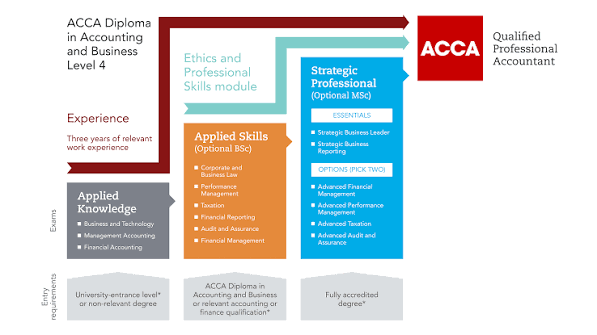
The full ACCA qualification has 13 papers split across three levels. Here is what each level looks like.
Applied Knowledge
This is where most students begin. Three papers cover the basics of business, management accounting, and financial accounting:
- Business and Technology (BT)
- Management Accounting (MA)
- Financial Accounting (FA)
These are on-demand computer-based exams. You book them when you feel ready and appear at an ACCA-approved CBE centre. No need to wait for a quarterly window. Most students finish all three within six to nine months.
Applied Skills
Six papers make up this level:
- Corporate and Business Law (LW)
- Performance Management (PM)
- Taxation (TX)
- Financial Reporting (FR)
- Audit and Assurance (AA)
- Financial Management (FM)
Unlike the Knowledge papers, these follow quarterly exam sessions in March, June, September, and December. You can attempt four papers per session, with a cap of eight papers within any 12-month period.
Strategic Professional
Two mandatory papers and two optional papers (chosen from a list of four) complete the ACCA qualification at this stage.
Mandatory papers:
- Strategic Business Leader (SBL)
- Strategic Business Reporting (SBR)
Optional papers (pick two):
- Advanced Financial Management (AFM)
- Advanced Performance Management (APM)
- Advanced Taxation (ATX)
- Advanced Audit and Assurance (AAA)
SBL runs for four hours and uses a case study format. It pulls together strategy, finance, leadership, and ethics into one paper. Many students find this the hardest shift because it moves away from calculation-heavy questions toward applied judgment.
Step 4: Claim Exemptions If You Qualify
Students with accounting or finance degrees do not always start from scratch. ACCA awards exemptions for papers already covered through prior study.
B.Com graduates with accounting or finance subjects often get waivers for BT, MA, FA, and a few Applied Skills papers. The fee per waived paper stands at roughly £105 in 2026. You apply for these through the exemptions section on the ACCA website after registration.
Worth keeping in mind: just because you can skip a paper does not mean you should ignore the content. Applied Skills and Strategic Professional papers build on Knowledge-level concepts. Gaps from skipped papers tend to surface later.
Step 5: Complete the Ethics and Professional Skills Module
The Ethics and Professional Skills Module, called EPSM, is a non-negotiable requirement before you attempt any Strategic Professional paper. It is not an exam. It is an online module that takes roughly 10 hours to complete and costs £95 in 2026.
The module walks through real-world scenarios involving professional judgement, ethical decision-making, and communication. Most students knock it out during their Applied Skills preparation rather than leaving it for later.
Step 6: Log Your Practical Experience
Passing all 13 papers gets you close to membership but not there yet. ACCA also requires 36 months of relevant work experience through the Practical Experience Requirement (PER).
The PER has nine performance objectives. These cover areas like audit, financial reporting, and business management. Your job title does not have to say “finance” anywhere. If your day-to-day work touches budgeting, preparing reports, or supporting an audit team, that experience counts.
Everything gets recorded in MyACCA and signed off by a workplace supervisor or line manager. You can start logging experience from day one of working, even while studying.
What the ACCA Costs Actually Look Like in 2026
| Fee | Amount (GBP) |
| Initial registration | £35 |
| Annual subscription | £134 |
| Applied Knowledge exam (per paper) | £116 |
| Applied Skills exam (per paper) | £132 |
| Strategic Professional exam (per paper) | £162 |
| EPSM | £95 |
Students in India who register through an approved learning provider may get different fee structures. Always check before paying directly through the ACCA website.
How Long Does This All Take
No exemptions, studying part-time: three to four years on average. Degree exemptions, structured study plan: two to two and a half years in many cases.
The quarterly exam cycle means there are four chances a year to attempt Applied Skills and Strategic Professional papers. Students who plan each session in advance and do not leave large gaps between attempts tend to finish faster and with better results.
After Membership: Where ACCA Takes You
Once the papers are done, the EPSM is finished, and 36 months of PER is logged and approved, you apply for full ACCA membership. From that point, you carry the ACCA designation professionally.
Audit firms, banks, and financial services companies have been picking up ACCA members at a steady pace. On the job front, financial controller, tax manager, internal auditor, and management accountant roles tend to be where most people start. From there, many ACCA-qualified professionals move into finance director and CFO positions over time, particularly within MNCs and larger accounting practices.
India has seen real growth in demand for ACCA-qualified talent over the past few years. Big Four firms, regional accounting practices, and global companies with Indian offices are all hiring from this space regularly.
Students in India looking for structured preparation with faculty guidance and exam-focused planning can check out Zell Education, which offers ACCA training programmes designed around the actual exam calendar.
