



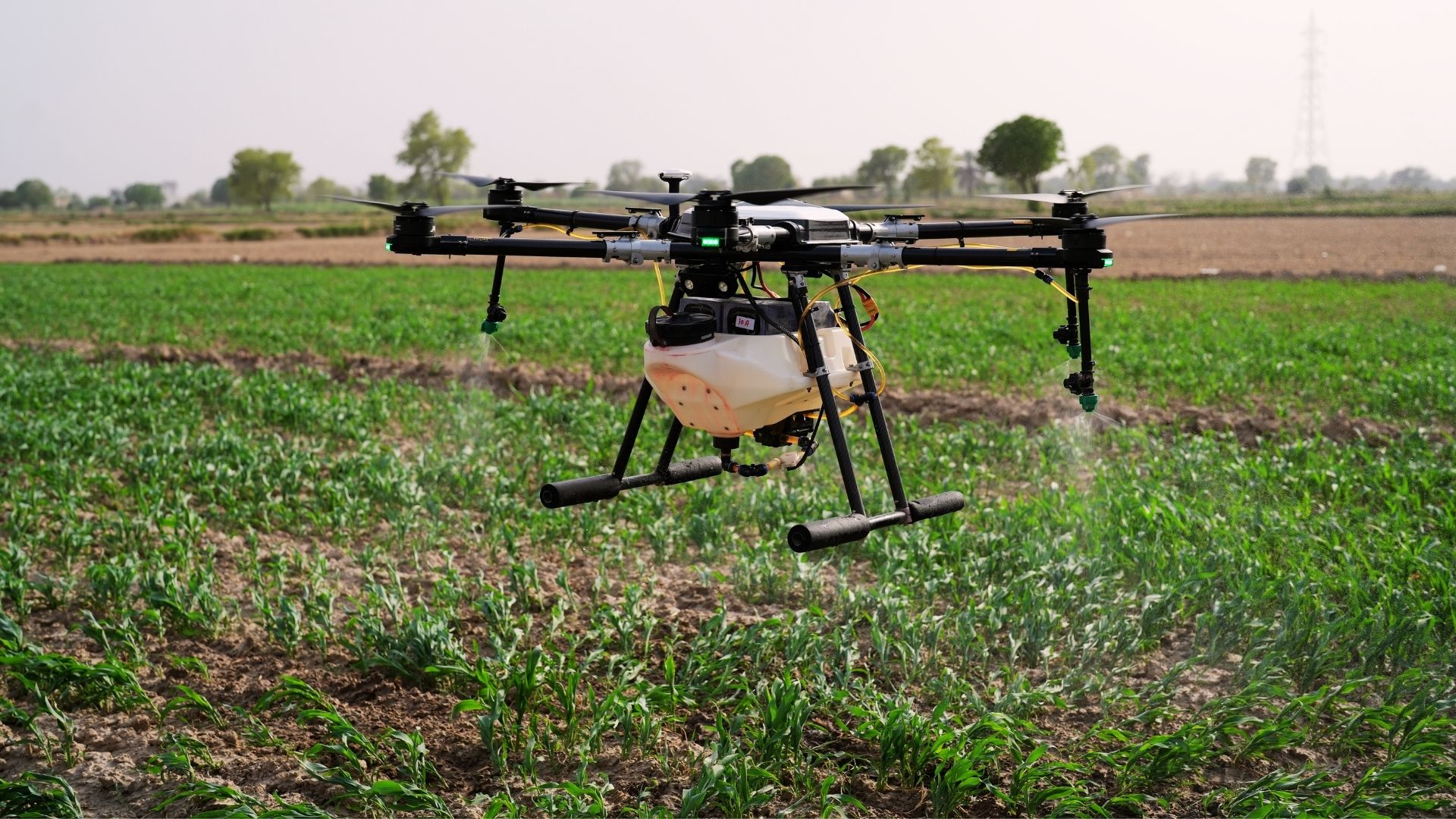
Agriculture in India is becoming more technology-driven as farmers look for faster, safer, and more efficient ways to manage crop care. Indian agriculture is steadily moving toward more efficient and technology-enabled field operations.
Government data shows that 2,122 drones were approved for distribution to individual farmers and Custom Hiring Centres between 2023–24 and 2025–26 under SMAM, reflecting growing institutional support for drone use in agriculture.
As access improves, agricultural drones for farming are becoming an increasingly practical solution for spraying, monitoring, and other time-sensitive farm activities in India.
What Are Agricultural Drones?
Agricultural drones are unmanned aerial systems designed to support a range of farming activities with greater speed, precision, and efficiency. Instead of relying only on manual labour or ground-based equipment, farmers can use drones to monitor fields from above, assess crop conditions, and carry out targeted operations such as spraying or input application.
In modern agriculture, these drones are becoming valuable tools because they help make farm management more accurate, timely, and resource-efficient.
Key ways agricultural drones are used:
- Crop spraying: Drones can apply pesticides, herbicides, and other crop protection inputs more quickly and evenly across the field.
- Field mapping: They help capture aerial views of farmland, making it easier to understand field layout, variation, and operational needs.
- Crop health monitoring: Drones can be used to observe crop conditions, detect visible stress, and identify areas that may need attention.
- Fertilizer application: Some agricultural drones are also used to support more targeted and efficient fertilizer spreading.
- Precision farming support: By improving monitoring and application accuracy, drones contribute to more data-led and precise farm management.
These functions make agricultural drones an increasingly important tool in modern farming, especially where speed, accuracy, and efficient resource use matter.
Benefits of Agricultural Drones for Farming
Agricultural drones offer practical benefits by helping farmers carry out important field tasks more quickly, accurately, and efficiently. From improving spray coverage to reducing labour pressure and supporting better resource use, they make farm operations more responsive and easier to manage.
As agriculture becomes more time-sensitive and precision-focused, these benefits are making drones an increasingly valuable tool in modern farming.
1. Faster field operations
Drone-based services can cover fields much more quickly than many manual methods. Leher states its spraying service can cover up to 50 acres per day, helping farmers respond faster during narrow treatment windows.
2. Better resource efficiency
A more precise application can improve the use of water and agro-inputs. Leher says its drone spraying model can save up to 90% water, reduce inputs by up to 40%, and lower costs by about 20% in its use cases. These are company claims, but they fit the broader logic of targeted spraying.
3. Improved worker safety
Traditional spraying can expose workers directly to chemicals. Drone-led spraying creates a greater distance between the operator and the spray zone, which helps reduce direct exposure during application. Leher explicitly highlights “no human exposure” as one of the advantages of its model.
4. Easier access through service models
For many farmers, the main barrier is not interest but ownership cost and operational complexity. Service-based platforms help solve that. Leher’s site and related pages describe a “book → spray → pay” model that connects farmers with certified drone operators instead of requiring every farmer to purchase and maintain a drone.
Challenges in Adopting Agricultural Drones
Agricultural drones offer clear advantages, but adoption is not always immediate or easy. For many farmers, the challenge is not only understanding the technology but also figuring out how it fits into day-to-day farm operations. Factors such as awareness, training, access, and cost perception can all influence how quickly drone use becomes practical at the field level.
Key challenges in adoption:
- Limited awareness among farmers: Many growers are still unfamiliar with how agricultural drones work or how they can be used in routine crop management.
- Training and operational knowledge: Drone-based farming requires skilled handling, planning, and safe application practices, which can create a learning barrier.
- Cost perception: Even when drones are available as a service, some farmers may still assume the technology is too expensive or difficult to access.
- Regulatory and compliance concerns: Understanding rules, permissions, and safe operating standards can feel complex for first-time users.
- Access to local drone services: Adoption can be slower in areas where trained operators or service providers are not yet widely available.
- Hesitation around changing traditional practices: Farmers who are used to manual or conventional spraying methods may take time to trust and adopt a new approach.
- Maintenance and technical support gaps: In places where service networks are still developing, technical issues or a lack of support can affect confidence in the technology.
These challenges show that wider drone adoption in agriculture will depend not only on the technology itself, but also on awareness, accessibility, training, and reliable on-ground support.
Why Service-Based Drone Access Is Growing
Service-based drone access is growing because it makes agricultural drone technology easier to use in real farming conditions. Instead of asking every farmer to purchase, manage, and operate a drone independently, this model allows them to access drone services as needed.
Why this model is gaining traction:
- Lower entry barrier for farmers: Farmers can use drone services without making a large upfront investment in equipment.
- No need for direct ownership: The service model removes the pressure of buying, maintaining, and managing the drone independently.
- Access to trained operators: Farmers can benefit from drone technology through experienced service providers instead of needing to learn operations themselves.
- Makes precision spraying more practical: On-demand access helps farmers use drone spraying during critical crop stages when timing matters most.
- Better fit for small and medium farms: Service-based access is often more realistic in farming systems where full ownership may not be economically practical.
- Reduces operational complexity: Scheduling a service is often easier than dealing with compliance, piloting, maintenance, and technical support on an individual level.
- Supports faster adoption of agri-tech: When advanced tools are available as a service, farmers are more likely to try and trust them in everyday operations.
Advantages show why service-based drone access is making agricultural drone technology more usable, scalable, and relevant for modern farming in India.
Conclusion
Agricultural drones are becoming an important part of modern farming because they help improve speed, precision, and efficiency in everyday field operations. From crop spraying and monitoring to mapping and input application, they support farmers in managing crop care more effectively while reducing operational strain.
As agriculture becomes more time-sensitive and resource-conscious, drone technology is proving to be a practical tool rather than just an emerging innovation.
As access continues to improve through service-based models and growing on-ground support, agricultural drones for farming are likely to play an even bigger role in shaping the future of Indian agriculture. Their value lies not only in advanced technology, but in how they help make farming more responsive, efficient, and better suited to modern agricultural needs.