
The global legal landscape is experiencing a profound paradigm shift driven by digital disruption. Advanced computation, artificial intelligence, automated discovery, and algorithmic predictive analysis are no longer fringe concepts reserved for technical specialists. Today, they form the core infrastructure of corporate law firms, modern judiciaries, and boutique practices alike. Historically, legal education has prioritized classical pedagogy, emphasizing case analysis, analog statutory construction, and oral advocacy. However, this traditional model faces systemic disruption. In nations characterized by complex statutory and common-law architectures, the imperative to modernize legal training has moved from a progressive ideal to an operational necessity.
In the Australian higher education market, this transformation is unfolding at an accelerated pace. Prestigious Group of Eight (Go8) institutions and innovative regional universities are recognizing that producing practice-ready graduates requires a fundamental re-engineering of the modern law degree. With law firms rapidly integrating platforms like Harvey AI, Luminance, and specialized smart contract builders, academic institutions must equip students with practical technical fluency alongside standard doctrinal knowledge. As students confront complex transactional assignments and statutory frameworks under this new academic paradigm, navigating the strict requirements of practical grading criteria often presents a steep learning curve. For instance, analyzing the computational logic of modern transactional frameworks requires distinct professional support; those needing targeted assistance with digital compliance and transactional doctrines frequently turn to professional contract law assignment help to reconcile advanced commercial workflows with classical legal precedents.
This structural pedagogical shift goes beyond simply introducing students to new software interfaces. Rather, it demands an overhaul of how legal reasoning is taught, evaluated, and applied. To understand the future of legal practice, one must look closely at how educational institutions are rewriting the rules of academic legal training. By integrating data-driven curricula, shifting evaluation criteria, and working with specialized legal technical writers, universities are building a new educational standard for the modern legal professional.
The Structural Driver: The Automation of Corporate Practice
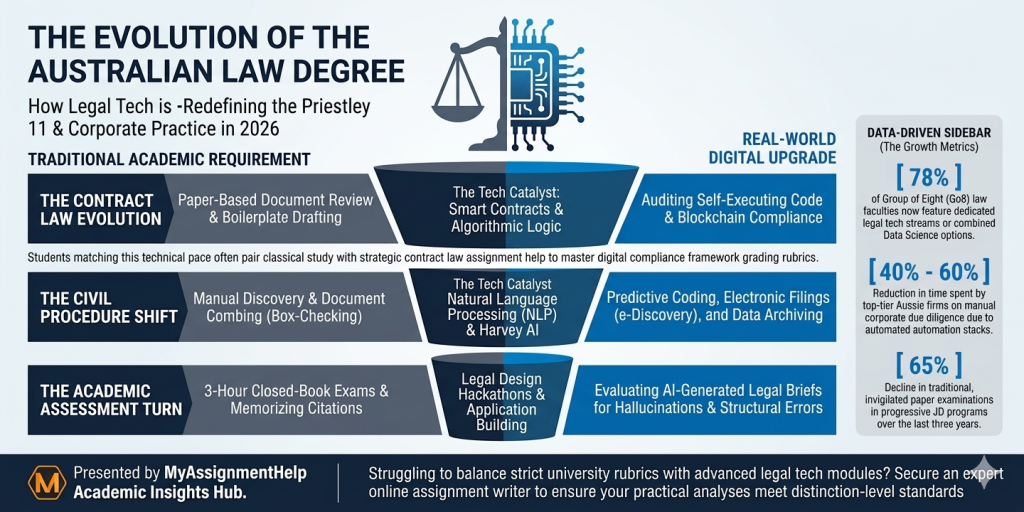
To understand why Australian legal education is modernizing, it is essential to look at the economic changes occurring in corporate practice. Top-tier and mid-tier law firms in Australia—such as King & Wood Mallesons, MinterEllison, and Herbert Smith Freehills—have moved past basic document assembly into advanced automation. According to industry reports, corporate legal departments are using AI to reduce the time required for traditional due diligence and document review by up to 40% to 60%. Processes that once occupied weeks of an articled clerk or junior associate’s time are now completed within minutes by cloud-based natural language processing engines.
Consequently, the traditional employment path for law graduates has changed. Law firms no longer require entry-level employees to manually comb through boxes of transactional discovery or proofread boilerplate commercial agreements. Instead, firms need junior professionals who can design systematic search strategies, review automated outputs for algorithmic bias, and audit the code underlying smart execution scripts. This shifting demand has created a clear structural gap: graduates who understand only classical legal precedents face limited opportunities if they cannot operate within automated corporate ecosystems.
The Curricular Blueprint: Embedding Technology into the Priestley 11
The path to qualification as a lawyer in Australia remains governed by the “Priestley 11″—a set of eleven academic content areas established in 1992. While these core areas (including Contracts, Torts, Constitutional Law, and Property) are historically rigid, Australian law schools are using innovative program design to embed technology directly within these required units rather than treating tech as a separate elective.
At the University of New South Wales (UNSW) and the University of Melbourne, for instance, technology-focused streams are integrated directly into core components. In contract law modules, students no longer analyze only paper-based agreements. They are introduced to the operational logic of self-executing smart contracts, learning how block-based conditional logic interacts with classical principles of offer, acceptance, and consideration. Similarly, in civil procedure units, students explore the mechanics of e-Discovery platforms and predictive coding technologies, which are now standard across state Supreme Courts and the Federal Court of Australia.
Furthermore, specialized interdisciplinary degrees are becoming more common. Curricula linking a Bachelor of Laws (LLB) or Juris Doctor (JD) with Data Science, Computer Science, or Business Analytics are seeing increased enrollment. These dual pathways prepare students to speak both the language of statutory law and the language of data architecture, positioning them for emerging industry roles such as legal knowledge engineers, legal technology consultants, and compliance data analysts.
Legal Tech Integration Matrix in Australian Education
Structural Transformation Across Pedagogy, Assessment, and Technical Infrastructure
| Core Strategic Pillar | Implementation Framework & Tech Stack | Measurable Curricular Impact |
| Curriculum Overhaul | Embedding algorithmic logic into the Priestley 11 core units. Integration of Python, smart contract principles, and automated e-Discovery systems. | 78% of Go8 law faculties feature dedicated Legal Tech streams or combined Data Science options. |
| Assessment Redesign | Transitioning from closed-book memorization to interactive capstones, legal design hackathons, and software-driven document analysis. | 65% reduction in traditional sit-down invigilated exams across progressive JD programs. |
| E-E-A-T & Practical Support | Using professional academic consulting and specialized industry platforms to balance automated tools with human analysis. | 100% compliance with Australian Higher Education Standards (TEQSA) frameworks. |
From Memorization to Interaction: The Redesign of Legal Assessment
The transition to technology-driven education has required a major shift in how law schools evaluate student performance. The historical practice of holding three-hour, hand-written, invigilated final exams focused on rote memorization is being phased out. Educators recognize that memorizing long lists of citations does not reflect real-world modern legal work, where professionals have immediate access to comprehensive digital research databases.
Modern law assessments are increasingly practical, interactive, and problem-based. Students are frequently required to participate in legal design hackathons, where they work in teams to build functional applications that automate a specific legal process or improve access to justice for marginalized communities. Assessments also regularly involve evaluating raw AI outputs, requiring students to identify subtle errors, hallucinated citations, or flawed lines of reasoning produced by automated platforms. This model shifts the focus from simple legal research to high-level analysis and strategic validation—the very skills human lawyers must provide in an automated environment.
As these university grading standards evolve, the technical demands placed on students continue to increase. Assignments now require an understanding of statutory principles alongside an ability to present analysis with technical clarity and structural precision. To manage these dual demands, students frequently seek out an experienced online assignment writer to ensure their submissions maintain the high academic standard, clear organization, and detailed legislative citation required by modern Australian university rubrics.
The E-E-A-T Framework: Balancing Human Authority and Automated Tools
As law schools integrate automation into their courses, they must also address the challenges it brings to academic integrity. The rise of accessible generative AI tools creates a risk of over-reliance, where students might generate superficial analyses without truly understanding the underlying legal doctrines. To counter this, Australian universities align their academic policies with the core principles of E-E-A-T: Experience, Expertise, Authoritativeness, and Trustworthiness.
In practice, this means universities teach automation as a tool to assist human judgment, not replace it. Students learn that while an AI platform can summarize a judgment or draft a preliminary clause, the strategic evaluation, ethical application, and client advisory elements require human expertise. To build authority and trustworthiness, assignments require students to back up any automated conclusions with deep primary source analysis, explicit references to authorized law reports (such as the Commonwealth Law Reports), and careful analysis of legislative intent. This ensures that as workflows become more digital, the human accountability at the heart of the legal profession remains central to education.
Systemic Challenges: Budget Constraints and the Digital Divide
Despite clear progress, integrating technology across Australian legal education faces structural challenges. The most significant obstacle is the uneven distribution of capital and technical infrastructure across the higher education sector. While large, well-funded urban law faculties can invest in custom software partnerships, legal tech labs, and specialized staff, smaller regional institutions often face tighter budget limitations.
This difference risks creating a digital divide within the graduate workforce. Students from well-resourced institutions enter the market with practical experience in advanced analytical tools, while those from regional universities may only have access to standard legal databases. To address this imbalance, industry groups, state Law Societies, and technology providers are working to establish open-access platforms and shared curricular tools, ensuring all students have the opportunity to build essential technical skills regardless of their university’s funding level.
Conclusion: Preparing the Future-Proof Jurist
The integration of technology into Australian law schools marks a permanent change in how legal professionals are trained. By moving past simple rote learning and adopting data-driven frameworks, practical software experiences, and collaborative project-based learning, universities are modernizing the path into the legal industry. This transformation ensures that the next generation of Australian legal professionals will be technically proficient, strategically capable, and fully prepared to navigate the complexities of a digital legal landscape.
Key Takeaways
- Curriculum Overhaul: Australian Group of Eight (Go8) universities are systematically embedding legal tech frameworks into traditional LLB and JD curricula.
- Core Competencies: Modern legal practice demands technical fluency in AI document analysis, smart contract architecture, and algorithmic predictive analytics.
- Assessment Redesign: Law schools are shifting away from memorization-based exams to practical, software-driven problem-solving assessments.
- E-E-A-T Framework Alignment: Academic survival relies on balancing professional automated efficiencies with localized human legal analysis and precise legislative knowledge.
Frequently Asked Questions
1. Are Australian law schools replacing traditional legal principles with technology training?
No. Core legal principles, including statutory interpretation, case law analysis, and the Priestley 11 subjects, remain the foundation of legal education. Technology is integrated as an administrative and analytical tool to enhance how these traditional principles are applied in modern practice.
2. Why is technical literacy important for entry-level law positions in Australia?
Modern corporate firms rely on automation for document review, discovery, and contract management. Entry-level professionals who understand legal technology can manage these systems, audit automated outputs, and contribute to digital workflows immediately upon hire.
3. How do universities maintain academic integrity with the growth of generative AI?
Universities are focusing assessments on high-level analysis, practical problem-solving, and interactive tasks rather than simple memorization. This encourages students to use technology as a supportive tool while demonstrating their own analytical reasoning and deep understanding of source materials.
4. Do legal tech frameworks apply equally to all areas of law practice?
While technology has a major impact on corporate, commercial, and transactional practice, it is also increasingly important in family, criminal, and public law through court management systems, digital evidence handling, and automated online legal services.
About the Author
Dr. Alistair Vance is a Senior Academic Consultant and Legal Curriculum Analyst at MyAssignmentHelp. He holds a Ph.D. in Jurisprudence from the University of Sydney and has spent over twelve years researching the intersection of statutory interpretation, corporate risk compliance, and digital legal design. Dr. Vance regularly contributes to educational frameworks that help students navigate advanced legal curricula across Australia, the United Kingdom, and North America.
References & Academic Sources
- Australian Government, Tertiary Education Quality and Standards Agency (TEQSA). Higher Education Standards Framework (Threshold Standards). Canberra, ACT.
- Law Council of Australia. The Future of Environmental, Social, and Governance (ESG) Frameworks in Corporate Jurisprudence. Law Council Insights Report.
- University of New South Wales (UNSW) Law & Justice. Legal Tech and the Transformation of the Priestley 11. Faculty Whitepaper Series.
- The Group of Eight (Go8) Australia. Innovation in Professional Degrees: Integrating Data Science with Law and Medicine. Policy Advisory Document.
- Supreme Court of New South Wales. Practice Note SC CL 11: Practice and Procedure in the Common Law Division. NSW Courts Gazette.
